
The US PFAS Regulatory Environment — From a State-Led Patchwork to Federal Accountability
PFAS (per- and polyfluoroalkyl substances) are a large group of synthetic chemicals widely used in non‑food consumer products. They are commonly found in textiles and apparel, footwear, electronics, cosmetics, cleaning products, surface‑treated plastics, paper, and packaging, where they provide water resistance, oil repellency, stain protection, and durability.
What makes PFAS especially challenging is their extreme persistence. These chemicals do not break down naturally and can accumulate over time in the environment and the human body. For this reason, they are often called “forever chemicals.” In the United States, growing public and regulatory concern has shifted attention away from individual substances toward broader controls on PFAS as a chemical group but through a uniquely complex mix of federal action, state legislation, and enforcement mechanisms.
This blog post will guide you through the rapidly evolving US PFAS regulatory landscape, explain why state by state rules are creating new compliance and supply chain risks, and outline what you can do today to stay compliant, avoid disruptions, and prepare for what’s coming next.
This blog will cover:
1. US’s Fragmented Regulatory Framework
2. State Regulations: A Fast Moving Patchwork
3. Testing for Compliance
4. Two Different Playbooks: Comparing EU and US PFAS approaches
5. Turning PFAS Compliance into a Strategic Advantage
US’s Fragmented Regulatory Framework
Unlike the European Union’s more centralized regulatory model, US PFAS regulation is fragmented and evolving, with significant activity occurring at the state level, particularly regarding consumer products. Regulation of PFAS in the United States is characterized by a multi-level regulatory framework involving both federal authorities and state governments.
| Level | Regulatory Focus | Key Characteristics |
|---|---|---|
| Federal | Chemical management, environmental contamination, reporting | Framework laws; limited direct bans on consumer products |
| State | Product restrictions, disclosure, and bans | Rapidly expanding and increasingly stringent |
The Federal Front: A rapidly shifting regulatory Arena
At the federal level, the United States does not have a comprehensive ban or uniform restriction on PFAS in consumer products. Federal PFAS regulation focuses primarily on:
Chemical manufacture and reporting,
Environmental releases and contamination (e.g., water),
Chemical risk evaluation and new chemical review.
The Toxic Substances Control Act (TSCA) is the main federal law regulating the manufacture, import, and risk evaluation of PFAS in the United States. Under TSCA, the EPA reviews new chemicals before market entry and may impose restrictions. The agency has issued Significant New Use Rules (SNURs) requiring notification before certain PFAS uses begin or resume. In 2024, the EPA finalized a rule barring the manufacture or processing of 329 PFAS listed as “inactive” on the TSCA Inventory. Earlier SNURs also require notification before using certain long chain PFAS in imported articles such as textiles, furniture, carpets, and electronics.
In 2023, the EPA finalized a comprehensive PFAS reporting rule under TSCA Section 8(a)(7), requiring manufacturers and importers, including those of PFAS containing articles, to report information on production volumes, uses, disposal, exposures, and hazards for PFAS manufactured or imported since January 1, 2011. Reporting deadlines are October 13, 2026, for most companies and April 13, 2027, for small businesses importing PFAS containing articles. However, in April 2026, the EPA announced plans to revise the rule and delay the start of reporting to 60 days after the effective date of the final revision, signaling possible further changes.
The Food and Drug Administration (FDA) oversees food-contact materials. In February 2024, the agency announced completion of the voluntary industry phase-out of PFAS grease-proofing agents in paper and paperboard food packaging. In January 2025, it formally revoked 35 related food-contact notifications. Limited authorized PFAS uses remain in other food-contact applications (e.g., nonstick coatings or gaskets), subject to ongoing safety reviews. No federal prohibitions exist for intentionally added PFAS in cosmetics or most other consumer goods, though the FDA continues monitoring exposure via the Total Diet Study and notes data gaps for cosmetic PFAS.
Beyond the EPA’s existing rulemaking, the US Congress reintroduced the Forever Chemical Regulation and Accountability Act in March 2026, which reflects growing bipartisan momentum to hold chemical manufacturers and downstream users accountable for PFAS contamination and consumer exposure. The legislation targets several longstanding gaps in PFAS oversight.
Expand EPA’s authority to designate PFAS substances as hazardous more rapidly under existing federal statues
establish a national framework to phase out “non‑essential” PFAS uses in products within 10 years,
introduce accelerated bans for certain consumer categories (such as food packaging, carpets, cosmetics and textiles), and
expand federal reporting and public disclosure obligations.
While the legislative timelines in the US Congress are rarely predictable, the introduction of this act is a clear signal: federal PFAS policy is moving in one direction beginning with harmonizing the currently fragmented, state driven PFAS in products landscape, while allowing stricter statelevel controls to continue.
State Regulations: A Fast Moving Patchwork
In the absence of a unified federal consumer product ban on PFAS, US states have become the primary drivers of PFAS restrictions in consumer products – and the result is a fragmented mosaic of regulations that creates significant complexity for any brand selling nationally.
What began several years ago with narrow, product specific laws has evolved into a broader legislative trend: states are no longer regulating isolated PFAS uses; they are increasingly targeting intentionally added PFAS across entire product categories. This shift reflects a clear pattern. Early state laws focused on high visibility items such as firefighting foam and food packaging. More recent legislation expands far beyond that scope, covering textiles, apparel, footwear, children’s products, personal care items, electronics, and packaging materials. For many brands, this means PFAS compliance obligations are no longer limited to a few SKUs but potentially affect entire collections.
Leading States Setting the Tone
Maine and Minnesota are the trend setters which stand out as the most ambitious in scope and have become models that other states are actively studying and emulating.
Maine's LD 1503, signed into law in 2021, is arguably the most comprehensive state-level PFAS law in the country for consumer products. It requires manufacturers of products containing intentionally added PFAS to report those products to the Maine Department of Environmental Protection. The law applies broadly across product categories, with reporting requirements phased in over time. Maine's ultimate goal is to prohibit the sale of products containing intentionally added PFAS by 2030 with limited exceptions where safer alternatives are not currently available.
Minnesota's Amara's Law, signed in 2023, followed a similar approach. It requires manufacturers to disclose products with intentionally added PFAS to the Minnesota Pollution Control Agency (MPCA), phased in by product category from 2025 onward. Several product categories face outright prohibitions on PFAS use under defined timelines.
Minnesota's Amara's Law, signed in 2023, followed a similar approach. It requires manufacturers to disclose products with intentionally added PFAS to the Minnesota Pollution Control Agency (MPCA), phased in by product category from 2025 onward. Several product categories face outright prohibitions on PFAS use under defined timelines.
As of writing, a growing number of states including California, Colorado, Washington, New York, Vermont, Connecticut, and Maryland have enacted or are actively advancing PFAS-specific laws affecting different consumer products categories.
Table 1: US States Enacted PFAS regulations for consumer products (as of Apr 2026)
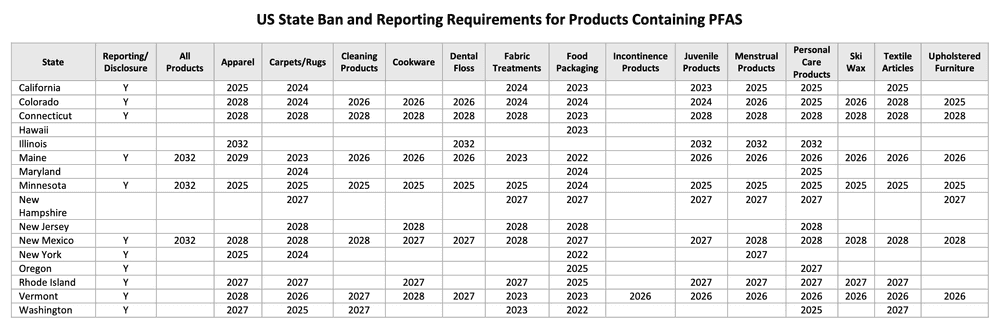
We predict going forward more and more states will adopt the "Minnesota model", moving away from banning specific items and toward a blanket ban on all PFAS across all consumer goods, unless the use is deemed strictly essential for health or safety.
Testing for Compliance
Because US PFAS regulations are state‑driven and highly fragmented, there is no single, federally mandated testing method for PFAS in consumer products. Instead, brands are expected to select testing approaches that are fit for purpose, defensible, and aligned with how individual state laws define and regulate PFAS.
There are two primary approaches to PFAS testing for non-food consumer products, and in some cases, laboratories will use a combination of both:
1. Total Fluorine (TF) and Total Organic Fluorine (TOF) Screening
This is the first-line, broad-spectrum approach. Total Fluorine Screening and Total Organic Fluorine Screening are basic tests that companies often use to check if PFAS are present at all. Total fluorine screening measures all the fluorine in a sample. The sample is combusted and the resulting gases are analyzed using ion chromatography.
2. Targeted Analysis
Targeted PFAS analysis is designed to identify and measure specific PFAS compounds that are regulated or restricted under EU law. The sample is extracted, and specific PFAS compounds are separated and identified using LC-MS/MS and/or GC-MS/MS.
Many US states do not require a specific test method, but they do expect companies to demonstrate that their products comply with broad legal definitions of PFAS. This creates practical implications for testing strategy:
States banning “intentionally added PFAS” → TOF or TF screening is often the most defensible starting point. States requiring PFAS reporting or registration → Targeted testing may be needed to identify substances for disclosure.
States expanding laws to multiple product categories → Screening‑first approaches help manage cost and complexity.
Importantly, passing a targeted PFAS test alone does not always demonstrate compliance with class‑based bans—especially when non‑targeted or alternative PFAS chemistries may still be present.
Two Different Playbooks: Comparing EU and US PFAS approaches
For brands and manufacturers operating in both the US and European markets, understanding how the two regulatory systems differ and where they converge is critical for managing dual compliance efficiently. While the US relies on state-driven action plus federal reporting, the European Union is pursuing a unified, class-based strategy under REACH.
| European Union | United States | |
|---|---|---|
| Structure | Unified | Fragmented |
| Regulatory Approach | Class-based, precautionary | Targeted/chemical-by-chemical (evolving toward class) |
| Primary instruments | REACH Regulation | TSCA (EPA) + state Laws |
| Disclosure Obligations | SVHC Reporting obligations for articles | TSCA 8(a)(7) reporting + state-level registration |
| Product Focus | Broad, across all product categories | Growing, but still evolving |
For companies selling in both markets, the practical reality is alignment to the strictest standard. Many brands have already reformulated to meet anticipated EU requirements, which often satisfy most US state rules and simplifies declarations. However, EU-compliant PFAS levels and restricted substance lists do not automatically satisfy all US state reporting obligations, which may require active registration, disclosure filings, and product category-specific documentation regardless of chemical concentration.
Turning PFAS Compliance into a Strategic Advantage
PFAS compliance is not simply a matter of reading a regulation, conducting testing and updating a label. For brands, importers and manufacturers, the challenge is deeply embedded in how products are designed, sourced, and manufactured.
Since the PFAS regulations are state-driven and highly fragmented in the US, complexity at this scale can feel overwhelming. However, the brands and suppliers that emerge strongest will be those that approach PFAS compliance as a strategic opportunity, not just a regulatory obligation. Here’s how to take a structured, future focused approach.
1. Conduct a comprehensive product portfolio audit
Begin by building a clear picture of where PFAS may exist in your products. In the US, regulators are increasingly distinguishing between intentionally added PFAS (like water-repellent coatings) and unintentional presence (like contamination from manufacturing machinery or recycled content).
Key first steps include:
Assessing PFAS levels across your product portfolio
Conducting supply chain audits to identify potential unintentional PFAS sources at each stage of production
Prioritize high risk product categories first. Products historically associated with PFAS such as water repellent textiles, cosmetics, non stick cookware, and food contact materials should be at the top of your risk assessment list.
For importers or manufacturers selling into both EU and US markets, cross-reference this audit against anticipated EU class-based restrictions. A single audit that flags items against both US state intentionally added thresholds and EU structural definitions can prevent duplicated effort.
2. Map your target markets against State Patchwork
Until a comprehensive federal framework fully harmonizes requirements, state rules still matter and they vary significantly. A product sold in Vermont may face different prohibitions than the same item in Maine or Minnesota. In such cases, the "strictest state" rule applies.
Products placed on multiple US markets should comply with the strictest applicable state PFAS requirement (often Maine or Minnesota definitions)
Market specific restrictions may affect formulation, testing scope, labeling, and documentation timelines
Failing to map products against destination markets can result in products being compliant in one market but non compliant (and unsellable) in another.
For dual EU/US sellers, extend this mapping to include EU member states and the evolving REACH proposal. Building market-level regulatory mapping into product development and quality decision-making helps avoid costly withdrawals and last-minute reformulation.
3. Revisit your supplier agreements
Supplier transparency is one of the most persistent weak points in PFAS compliance. Strengthening contractual requirements now can significantly reduce future risk.
Best practices include:
Requiring formal disclosure of PFAS use and clear transition timelines
Adding right to test clauses to supplier agreements to support verification
Requesting “reasonable diligence” documentation that aligns with Minnesota and Maine standards
Many brands only discover during enforcement or retailer audits that Tier 2 and Tier 3 suppliers lack visibility into their own chemical inputs, creating compliance blind spots. Addressing these gaps proactively protects not only your regulatory standing but also your brand reputation, especially when supplying global retailers who demand consistent standards across US and EU channels.
4. Align your testing plan to current regulatory thresholds
PFAS testing is not a one-size-fits-all process. You need to ensure your testing programs are aligned with current legal thresholds, not outdated internal limits or legacy standards.
In practice, this means:
Testing against applicable US state limits, including intentionally added PFAS bans and emerging total organic fluorine (TOF) thresholds
Understanding the difference between screening values (TOF) and targeted legal limits, so internal decision-making is consistent and defensible.
Reviewing test scopes regularly, as new state rules add categories or tighten thresholds.
Regulatory thresholds keep evolving. Working with your quality parter to ensure your PFAS testing strategy stays aligned with what regulators expect today, not what was acceptable yesterday.
5. Prepare for multiple regulatory scenarios
The US federal landscape including the Forever Chemical Regulation and Accountability Act is still evolving. Final outcomes may include targeted phase-outs, broader essential-use frameworks, or continued state leadership, each with different operational impacts.
To stay resilient:
Monitor regulatory developments closely (both federal bills and state legislation)
Model multiple compliance scenarios and their cost, reformulation, and sourcing implications
For EU/US operators, prepare joint scenarios that satisfy both the EU’s class based approach and US state patchwork
PFAS risk management is not solely a compliance or sustainability issue. It requires cross functional coordination to ensure consistent decision making and execution.
6. Build documentation systems now
Documentation is the "spine" of US enforcement. Under the new TSCA reporting requirements, the EPA and state authorities like the Maine DEP can request years of technical data at any time.
Manufacturers should ensure they
Retain Records for the period demanded by individual states or federal rules
Demonstrate Due Diligence: Ensure you can quickly produce lab reports and supply chain maps to prove that any detected PFAS was not intentionally added.
Building robust documentation systems early reduces scramble, cost, and risk when enforcement begins or during retailer audits. For global brands, a centralized digital system that tags documents by market (US state vs. EU) is particularly valuable.
7. Keep an eye on broader developments in parallel
Focus on state-level developments while monitoring the federal bill and provisions that could override state requirements. For brands with EU distribution, keep track the REACH restriction timeline. Developing compliance programs adaptable to both US state variations and EU harmonization without requiring complete reformulation will save significant resources.
Conclusion
The US PFAS regulatory picture is complex, but the direction is clear: greater transparency, reduced intentional use, and ultimately safer products for consumers and the environment. By treating compliance as a supply-chain excellence initiative rather than a burdensome checkbox, brand, importers or manufacturers can deliver measurable value, protecting revenue, enhancing brand trust, and positioning their companies for long-term success in a sustainability-focused marketplace.
For brands operating across the US and EU, aligning to the strictest standards early creates efficiency and competitive advantage. The tide on forever chemicals is rising, but prepared teams are already riding it successfully.
Frequently Asked Questions
What are PFAS and why are they often called “forever chemicals”?
PFAS (per- and polyfluoroalkyl substances) are man-made compounds prized for water, oil, and stain resistance. Their carbon-fluorine bonds are extremely strong, so they don’t break down naturally, hence the nickname “forever chemicals.”
Which federal regulations govern PFAS in U.S. consumer products?
The EPA regulates PFAS under the Toxic Substances Control Act (TSCA), issuing Significant New Use Rules (SNURs) and Section 8(a)(7) reporting requirements. The FDA also oversees PFAS in food-contact materials, having phased out certain grease-proofing agents.
Which states have the strictest PFAS restrictions on consumer goods?
Maine’s LD 1503 and Minnesota’s Amara’s Law are the most comprehensive, requiring PFAS product disclosures and phasing in bans on intentionally added PFAS. Other states including California, Vermont, and Washington have similar targeted restrictions.
How do companies test products for PFAS compliance?
Most labs start with Total Fluorine (TF) or Total Organic Fluorine (TOF) screening to detect any fluorine. If screening indicates PFAS presence or specific state laws demand it, they follow up with targeted analysis (LC-MS/MS or GC-MS/MS) to quantify regulated PFAS compounds.
When are the TSCA Section 8(a)(7) PFAS reporting deadlines?
Reporting for large manufacturers and importers is due by October 13, 2026; small businesses have until April 13, 2027. Note that the EPA plans to revise and potentially delay these dates pending final rule updates.
How can companies stay ahead of evolving PFAS rules across different states?
Build a compliance roadmap by auditing your product portfolio for PFAS, mapping state-by-state requirements, tightening supplier agreements with right-to-test clauses and aligning your testing strategy to the strictest applicable standards.
References
Related Articles