
50 Years of OECD Responsible Business Conduct and 15 Years of the UN Guiding Principles: The Backbone of Due Diligence Today
In 2026, the responsible business community marks two major anniversaries: 50 years since the OECD introduced the world’s first international standard on responsible business conduct (RBC), and 15 years since the UN Human Rights Council endorsed the UN Guiding Principles on Business and Human Rights (UNGPs).
These milestones are more than dates on a calendar. They reflect the frameworks that have shaped how companies understand responsibility in global supply chain, shifting from “what’s legal” to “what’s responsible,” and from “what we audit” to “what we continuously manage, improve, and remediate.”
With new due diligence obligations emerging globally, policy makers are consistently building obligations on the foundations of both frameworks. Companies can address most of their obligations by building their policies, processes and supplier engagement on the frameworks’ principles to prepare for effective, risk-based human rights and environmental due diligence.
A Shared Foundation: From Principles to Practice
The OECD Guidelines for Multinational Enterprises on Responsible Business Conduct are non-binding recommendations to enterprises to prevent and address adverse impacts linked to business operations, products, and services, underpinned by a due diligence approach that is risk-based and continuous.
Since then, the OECD has provided crucial tools to effectively implement the guidelines for governments, initiatives and businesses:
Due Diligence Guidance for Responsible Business Conduct, outlining the now renowned 6-step due diligence process
Sectoral Due Diligence Guidance
National Contact Points (NCPs) for Responsible Business Conduct
e-Learning Academy on Responsible Business Conduct
Due Diligence Checker
Alignment assessments of sustainability initiatives
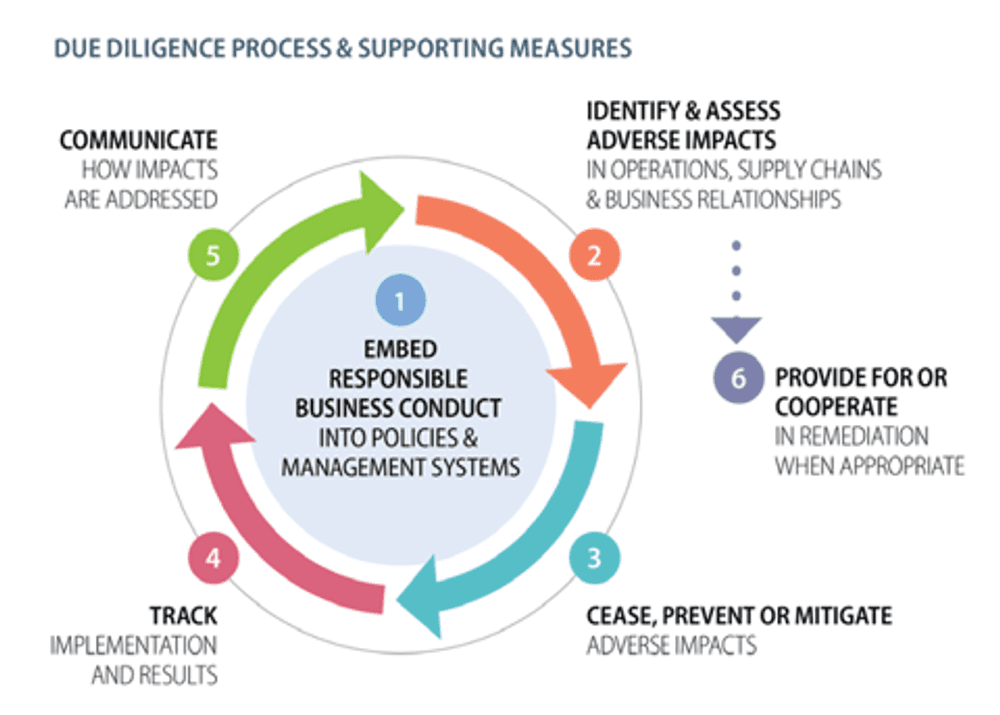
The OECD 6-step Due Diligence Framework
In parallel, the UN Guiding Principles created a globally recognized framework for business and human rights, anchored in “Protect, Respect and Remedy.” Shift’s 15th anniversary reflections emphasize that the UNGPs were intentionally designed as dynamic principles, not rigid rules, built to guide practice through changing contexts.
Together, these standards helped establish the common language used today by policy makers, civil society, initiatives, standards and companies.
How These Standards Shaped Regulation: The Rise of Mandatory HREDD
For years, supply chain due diligence was driven mostly by voluntary commitments and buyer requirements. That has changed as governments concluded that voluntary action alone would not consistently prevent serious harm in global value chains.
This shift is now visible in the growing landscape of human rights and environmental due diligence (HREDD) regulation. The OECD has mapped how legislation across jurisdictions often converges around a broadly similar due diligence framework rooted in international standards.
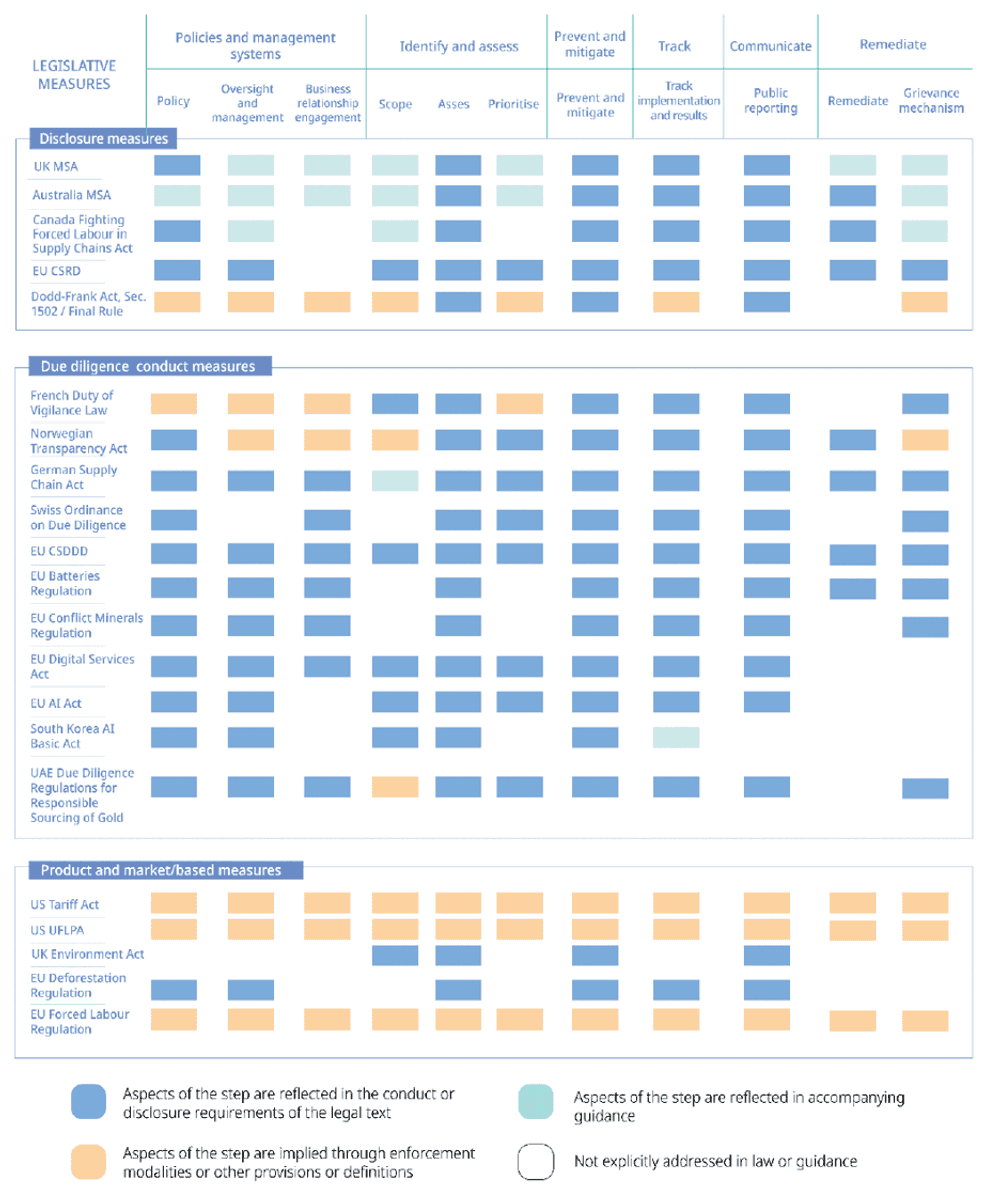
From: OECD Business and Finance Policy Papers, No 101
How the TIC Sector Operationalized These Standards: From Audits to Beyond Audits
As the OECD Guidelines and UNGPs shaped expectations, companies needed practical ways to translate “responsibility” into operational programs. This is where the TIC sector (Testing, Inspection, Certification) has played a central role.
Audits have long helped assess conformance against standards such as BSCI, SMETA, WRAP, Rainforest Alliance, codes of conduct, and regulatory requirements. A key message across both the OECD and UNGPs is that due diligence is not a one-time exercise. It is continuous, responsive to changing risks, and ultimately about outcomes for people and the environment.
That is why many companies have expanded beyond audit-only models into complementary approaches, including:
Going from snapshot compliance checks to risk-based planning and prioritization
Engaging with direct suppliers as well as broader business relationships
Risk identification and effective follow-up, prevention, and improvement
Establishing worker voice and grievance channels
Providing supplier training and capacity building
Implementing risk monitoring and better supply chain transparency
Audits remain an important due diligence input, but they are no longer the whole system
Looking Ahead: Why OECD and UNGPs Will Remain the Foundation of HREDD
Even as regulation evolves, the OECD Guidelines and the UNGPs remain the most widely recognized reference points for what responsible business conduct and due diligence mean in practice.
The OECD’s anniversary message underscores that in a world of multiple transitions, responsible business conduct and due diligence will remain central to fairer, more resilient supply chains. Shift’s UNGPs-at-15 reflections similarly stress the enduring value of a framework designed to guide practice through new challenges and new contexts.
For companies building or strengthening HREDD programs, these frameworks remain the anchor for credible, risk-based approaches to supply chain responsibility.
Key Timelines to Watch
USA: Updated Forced Labor Enforcement Operational Guidance for Importers: June 2026
EU Deforestation Regulation (EUDR): 30 December 2026
EU Batteries Regulation (EUBR) Supply Chain Due Diligence obligation: 18 August 2027 — Commission guidelines still pending, expected by 26 July 2026
EU Forced Labor Regulation (EUFLR): 14 December 2027
EU Corporate Sustainability Due Diligence Directive (CSDDD): 26 July 2029
Further monitoring of new legislation or revision proposals in Switzerland, Canada, New Zealand, South Korea and others.
Further Reading
Blog | Human Rights and Environmental Due Diligence in 2025-2026
Whitepaper | Human Rights Due Diligence: Fighting Forced Labor in Global Supply Chains
Whitepaper | Mandatory Human Rights & Environmental Due Diligence: How to Get Prepared
Want to talk more about how due diligence expectations are evolving - and what they mean for your supply chain?
Reach out to our team at info@qima.com and read more about supply chain due diligence here.
Related Articles


